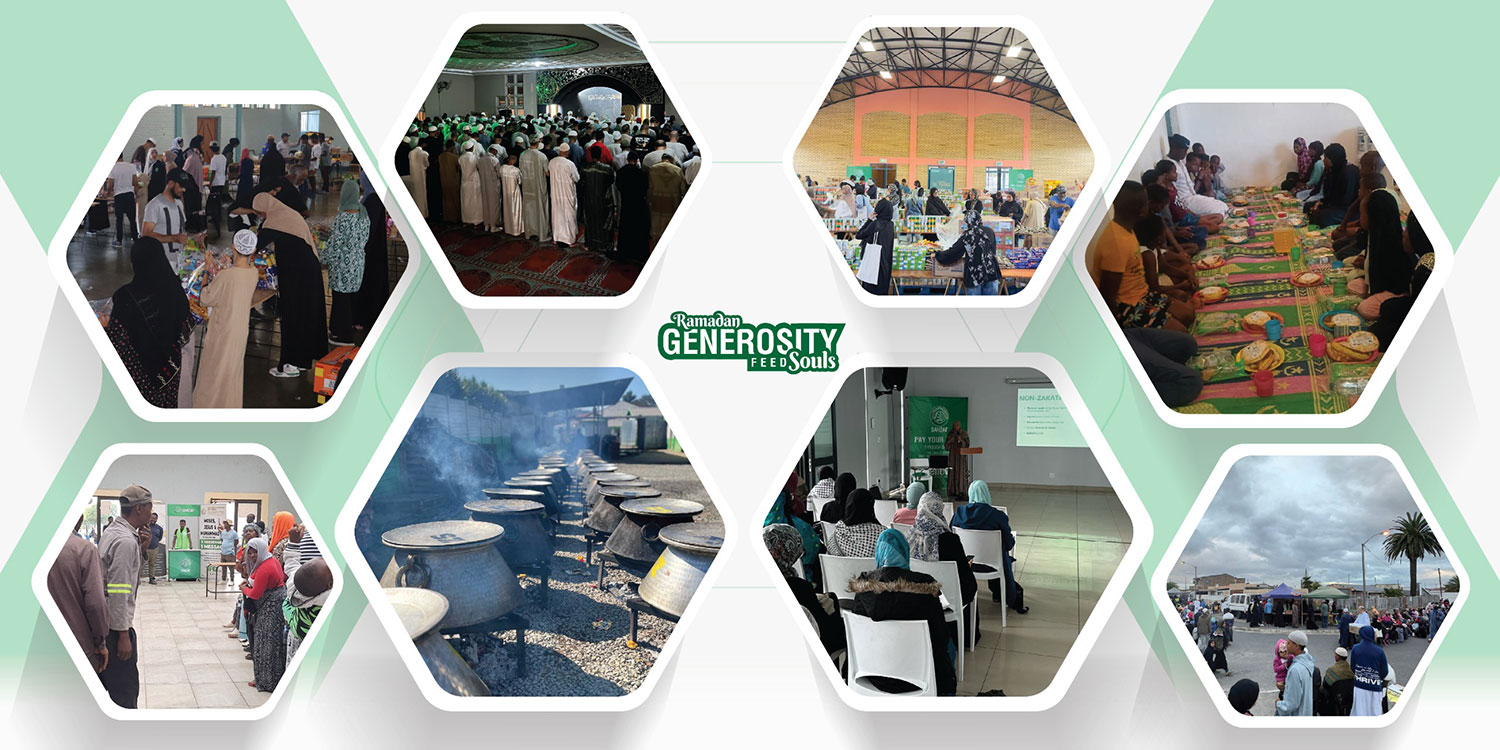
Generosity Feeds Souls, Ramadan in Action
During Ramadan, SANZAF’s work comes alive through the hands of volunteers, the generosity of donors and the support of Masajid and community partners across the country. From warm meals and Iftar packs to carefully prepared Fitrah hampers for Eid, every act of giving helps families feel seen, nourished and remembered. Through your Zakah, Sadaqah, Fitrah and Fidyah, Ramadan becomes more than a month of charity, it becomes a month of mercy and dignity shared with those who need it most.
Feeding the Fasting
As the day drew to a close and the call to Maghrib approached, the work of feeding the fasting became one of the clearest expressions of Ramadan’s mercy. Across communities, Iftar and Suhoor packs were distributed to individuals and families in need, ensuring that people had nourishment for both the breaking and beginning of their fast.
In KwaZulu-Natal, this support reached communities through the Inanda Mission Islamic Centre, Thornwood Islamic Centre, Umlazi Islamic Centre and Imaani Village in Umbumbulu. Each pack carried simple essentials, but its meaning was far greater. For the receiver, it was a reminder that they had not been forgotten. For the giver, it was an opportunity to serve with sincerity in the most blessed of months.
The spirit of shared meals also brought communities together through Mass Iftars. At Masjied Aziez in Pier Street, people gathered for an evening of reflection, gratitude and togetherness. The meal became a meeting point between neighbours, families and strangers, all sitting with the same purpose: to break fast in the warmth of community.
At Masjid Al-Fattaagh, SANZAF partnered with Al-Furqan for another beautiful Mass Iftar, feeding individuals and sharing the joy of the moment as one community. These gatherings created spaces where the fast ended with dignity, the heart softened with gratitude and the bonds of community were strengthened.
In Pietermaritzburg, the Ramadan feeding programme carried its own familiar rhythm. Throughout the month, the office cooked degs of food for the community, continuing a tradition of service that has become deeply rooted in the region. For the final Ramadan feeding, over 70 degs of food were distributed, ensuring that families in need had a warm meal with which to break their fast. Behind each deg was the labour of dedicated hands; behind each plate was the quiet message of care.
The month also saw SANZAF honoured to partner with Radio 786’s Shifaah Project, bringing much-needed support to communities every week. These Iftars were hosted at Masjidul Irshaad in Woodlands, Mitchell’s Plain; Aljaamia Uthmania Masjid, Bonteheuwel and Nurul Islam Masjid, Heideveld. In each location, the gatherings reflected the same truth: when communities come together, a meal becomes more than nourishment. It becomes mercy shared at the table.
Hampers Packed with Care, Delivered with Dignity
In community halls and offices, another part of Ramadan’s story unfolded around rows of boxes and busy hands. Essential hampers were packed not as parcels alone, but as promises of support to families preparing for Ramadan and Eid.
In Cape Town, at Rylands Civic Centre, volunteers and community members came together to pack Fitrah hampers, each item placed with care and intention.
In Gqeberha, the Muslim Movement Hall carried the same energy. Community members gathered to pack Fitrah hampers for families in need, ensuring that Eid could be welcomed with greater ease. The work was practical, but the feeling behind it was deeply personal. Every hamper represented a household, a family and a moment of dignity restored.
At the Bridgetown Office, based at Masjid Ighwatul Islam, dedicated community members and volunteers also came together to pack Fitrah hampers. In these moments, the act of packing became an act of worship. The boxes were filled with essentials, but also with the hope that families would feel supported, remembered and included.
In Kwa-Pata, SANZAF’s Zakah hamper distribution brought essential food supplies to families in need. Here, Zakah moved from obligation to impact. It entered homes as relief, easing the pressure of the month and reminding families that the wider community stood with them.
This circle of giving was strengthened through the generosity of Islamia High Academy, whose donation of food hampers helped extend the reach of support. Their contribution became part of a broader chain of compassion, where schools, donors, volunteers and communities each played their part in uplifting others.
As Ramadan drew closer to Eid, Fitrah distribution in Chatsworth ensured that families in need could celebrate with dignity. It was a simple but powerful intervention. For those receiving support, Eid was not approached with uncertainty, but with the comfort of knowing that their community had made space for their joy.
Learning, Reflection and Zakah with Purpose
While Ramadan is known for fasting and feeding, it is also a month of knowledge. This year, communities gathered in Masajid and learning spaces to deepen their understanding of Zakah, its calculation, its purpose and its power to transform lives.
At Heideveld Masjid, a spiritually enriching morning unfolded through the Ladies’ Thikr and Zakah Workshop. Sisters from the community came together for remembrance, reflection and valuable insight. The gathering carried the softness of Thikr and the clarity of learning, reminding attendees that Zakah is not only a financial duty, but a sacred trust that connects worship to social care.
In Mayfair, the Zakah Workshop at Masjid Abu Bakr Siddique sparked thoughtful engagement. Attendees asked meaningful questions, reflected on practical scenarios and left with a clearer understanding of how Zakah should be calculated and distributed. It was a space where faith met responsibility, and where knowledge became a means of ensuring that Zakah reaches those who need it most.
Further workshops at Masjid Tuba in Panorama and Quloobul Moe’mieneen Masjid in Goodwood continued this important work. These sessions gave communities a deeper understanding of Zakah, its calculation and its impact. They created room for questions, clarity and renewed intention, helping people fulfil their obligations with confidence and care.
Beyond the Masjid setting, the Zakah in Focus Series with Radio 786, VOC and Al Ansaar extended the conversation to wider audiences. Through these platforms, SANZAF explored the transformative power of Zakah and its ability to create lasting change. The series helped remind listeners that Zakah is not merely collected and distributed; it is a system of mercy, justice and dignity when carried out with knowledge and sincerity.
Meeting the Community Where They Are
Ramadan’s generosity was also present in public spaces, where SANZAF connected directly with communities.
Across South Africa, various pay points were set up to ensure that individuals and families could contribute their Fitrah, Fidyah, Zakah and Sadaqah. These points became more than collection stations. They were places of intention, where people paused in the busyness of Ramadan to ask questions and fulfill their obligations with ease.
This spirit was also felt at the vibrant Lenasia Eid Souk, where SANZAF connected with visitors and made it easier for people to fulfill their Zakah, Sadaqah and Fitrah. The weekend was filled with movement, conversation and the warmth of community.
Layl Programmes
Throughout the month of Ramadan and entering its most sacred nights, the spirit of unity and service deepened through the Layl programmes. These nights touched hearts in a special way, bringing together worship, reflection and community support.
In partnership with Khuddamul Islam, Quloobunnur and Khadimaat, the Layl programmes became spaces of spiritual connection and purpose. Their unwavering commitment helped make the nights impactful, especially for young people and community members who gathered to learn, serve and reconnect with the deeper meaning of Ramadan.
The Spirit That Remained
By the end of Ramadan, the story was not held in one place or one programme. It was held in many hands.
It was in the hands that packed hampers. It was in the hands that cooked and served over degs. It was in the hands that distributed Iftar and Suhoor packs. It was in the hands of those who welcomed communities at the Mass Iftar’s and was also in the hearts of those who came to learn about Zakah.
Ramadan was not simply a month of activities completed. It was a month of trust fulfilled, hunger eased, knowledge shared and dignity honoured.
And as Eid arrived, what remained was the reminder that the best of Ramadan is not only what we give during the month, but what we continue to carry after it: compassion, responsibility and a community willing to stand together.